Babys With Bile Problem How Long After Born Yhey Show Symptoms?
What is Biliary Atresia?
Biliary atresia is a rare disease of the liver and bile ducts that occurs in infants. Symptoms of the disease announced or develop about two to 8 weeks later on birth.
Cells within the liver produce liquid chosen bile. Bile helps to assimilate fat. It also carries waste products from the liver to the intestines for removal from the trunk.
This network of channels and ducts is called the biliary system. When the biliary organization is working the style it should, it lets the bile bleed from the liver into the intestines.
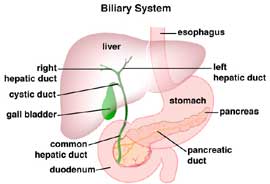
When a baby has biliary atresia, bile flow from the liver to the gallbladder is blocked. This causes the bile to be trapped inside the liver, quickly causing damage and scarring of the liver cells (cirrhosis). This eventually leads to liver failure.
Biliary atresia is the most common reason for liver transplantation in children in the U.S. Eighty-five percentage of all children who take biliary atresia will demand to have a liver transplant earlier they are 20 years onetime.
Survival after surgery has increased dramatically in recent years. Children with biliary atresia who have a liver transplant tend to do very well. Advances in treatment allow the choice of using a slice of an adult liver for transplant in a kid with biliary atresia. Every bit a effect, parents or other relatives of children with biliary atresia may now exist considered potential donors. This pick can dramatically reduce a child'southward time on the transplant waiting list.
Children with biliary atresia who do not need a liver transplant have some caste of liver disease. Their illness can be managed in other ways.
What Causes Biliary Atresia?
The causes of biliary atresia are non completely understood. For some children, biliary atresia may occur because the bile ducts did not grade properly during pregnancy. For other children with biliary atresia, the bile ducts may be damaged past the body'south immune organisation in response to a viral infection caused after nativity.
Who is at Risk for Biliary Atresia?
Biliary atresia is a rare disorder. About one in 15,000 to 20,000 babies practice non accept complete bile ducts.
Biliary atresia seems to affect girls more than boys. Inside the same family, it is common for only one child in a pair of twins or only 1 child inside the same family unit to have the disease. Asians and African-Americans are afflicted more than frequently than Caucasians.
At that place does not appear to be any link to medications taken during pregnancy.
Exercise Children with Biliary Atresia Accept Other Associated Abnormalities?
Ten to fifteen percentage of infants with biliary atresia may be born with other problems in the:
- Heart
- Spleen (polysplenia)
- Blood vessels (inferior vena caval anomalies, preduodenal portal vein)
- Intestine (situs inversus or malrotation)
What Are the Symptoms of Biliary Atresia?
Babies with biliary atresia ordinarily announced healthy when they are born. Symptoms of the disease typically appear within the first two weeks to two months of life. Symptoms include:
- Jaundice − a yellow coloring of the skin and optics due to a very high level of bilirubin (bile paint) in the bloodstream. Jaundice caused past an immature liver is common in newborns. It usually goes abroad within the first week to 10 days of life. A baby with biliary atresia ordinarily appears normal at birth but develops jaundice at two or three weeks afterward birth.
- Night urine − caused by the buildup of bilirubin (a breakdown product from hemoglobin) in the claret. The bilirubin is then filtered by the kidney and removed in the urine.
- Acholic stools (white or clay-colored stools) − because no bile or bilirubin coloring is beingness emptied into the intestine. Bile gives stool its dark-green or brown colour, and without such, stool is without colour (often white or grey).
- Weight loss and irritability − develop when the level of jaundice increases.
How Is Biliary Atresia Diagnosed?
Jaundice may be present with other liver disorders, then several tests are needed to get the right diagnosis.
- Blood tests are done to tell if there are liver function abnormalities. They may also identify the cause (etiology) of jaundice.
- X-rays of the abdomen wait for an enlarged liver and spleen.
- An abdominal ultrasound can tell if there is a pocket-size gall float or none at all. The gall float is the organ that stores bile. If this organ is missing or absent-minded since birth, that often indicates biliary atresia.
- A liver biopsy tells if an infant is likely to take biliary atresia. In a liver biopsy, a tiny sample of the liver is removed with a needle. That sample is and then looked at under a microscope. A liver biopsy is very reliable. If the biopsy shows that the infant probably has biliary atresia, farther surgery will confirm the diagnosis and treat the condition.
- Diagnostic surgery confirms if an infant has biliary atresia. Surgery allows doctors to run across if there is an injured piece of the bile ducts going from the liver to the intestine. This could prevent normal bile flow from the liver.
- An operative cholangiogram is done during the surgery to confirm the diagnosis of biliary atresia.
A cholangiogram is a procedure done at time of functioning. This procedure involves a dye that is injected through the gall float and goes through the bile ducts. An X-ray is washed to learn if the dye flows unremarkably into the intestine and the liver. In infants with biliary atresia, the dye does not usually period out of the gall bladder due to the blocked ducts.
If the ducts are normal or open (patent) and the dye flows the way information technology should, biliary atresia is ruled out. A bigger liver biopsy (tissue sample) is then done to find the cause of the liver disorder.
Biliary atresia is diagnosed when the cholangiogram shows that the bile ducts are not open. Then infants usually undergo an functioning called the Kasai procedure.
How is Biliary Atresia Treated?
Biliary atresia cannot be treated with medication. A Kasai procedure (besides known every bit a or hepatoportoenterostomy) is done. The Kasai procedure is an performance to re-establish bile menstruum from the liver into the intestine. Information technology is named after the surgeon who developed information technology.
The surgeon removes the damaged ducts exterior of the liver (called extrahepatic ducts) and identifies smaller ducts that are still open and draining bile. The surgeon then attaches a loop of intestine to this portion of the liver, so that bile can flow directly from the remaining salubrious bile ducts into the intestine.
After this procedure, infants are usually in the hospital for vii to 10 days to heal. Long-term antibiotic therapy is given to reduce the risk of infection, and additional medications may be used to promote bile period and maximize the success of the performance.
With an experienced surgeon, the Kasai procedure is successful in threescore to 85 percent of the patients. This means that bile drains from the liver and the jaundice level goes down.
The Kasai procedure is not a cure for biliary atresia, but information technology does permit babies to grow and have adequately good wellness for several, sometimes for many years. Nigh 25% of patients who undergo a Kasai procedure do non go on to crave a liver transplant.
In 15-40 percent of patients the Kasai procedure does not work. If this is the case, liver transplantation can correct this problem.
Success with the Kasai procedure is related to:
- Age. The younger an infant at the time of surgery, the more than likely the surgery will be successful. Past the fourth dimension an infant is older than about 3 to 4 months onetime, surgery is unlikely to exist helpful.
- Extent of cirrhosis (scarring and damage to liver tissue) at the time of surgery.
- The number and size of microscopic ducts in the scarred tissue that can drain bile.
- The nutritional status of the infant at time of transplant (sufficient vitamins, high calorie diet)
Nutrition and Biliary Atresia
Children with liver affliction have a faster metabolism than healthy children. This ways that children with biliary atresia may require more calories.
A child with biliary atresia and jaundice cannot properly digest fats. This is because not enough bile gets to the intestine. Due to liver harm, in that location may too exist a loss of vitamins and poly peptide.
Guidelines from your doctor for your child's nutrition may include:
- A well-balanced diet, consisting of three meals a mean solar day plus minor snacks in between meals
- Vitamin supplements (specifically Vitamins A, D, E, and K as these are captivated in fat, and children with biliary atresia cannot absorb these well)
- Adding medium-chain triglyceride (MCT) oil to foods and liquids or baby formulas. MCT adds extra calories that volition assist your child grow.
- High-calorie liquid feedings may be recommended if your kid is as well sick to eat normally. Feedings are given through a special tube (nasogastric tube) that is placed in the nose and guided down the esophagus and into the tum.
Although digestion may return to normal afterwards surgery, extra vitamins or MCT oil may be needed.
What Are the Complications of Biliary Atresia and What Tin Be Done for Them?
Complications right after surgery are low. Most bug that develop are due to progression of the liver disease.
- Later on the Kasai procedure, it is common to get an infection in the bile ducts. This is usually treated using intravenous antibiotics. Treatment may go along with oral antibiotics.
- Jaundice or itching may occur. These can often be treated successfully with medications such as cholestyramine and ursodeoxycholic acid (for itching).
- Many patients with cirrhosis have changes in blood flow through the liver and intestines. These changes may produce problems such as easy bruising of the pare, nosebleeds, retentivity of trunk fluid and enlarged veins (varices) in the tummy and esophagus.
Increased pressure in these veins can cause a sudden and large amount of bleeding in the breadbasket and intestines. Although this can exist a very serious complication, with prompt and experienced medical intendance, bleeding tin usually exist stopped. Sometimes that requires specialized procedures in which a hardening (sclerosing) agent is injected into the abnormal vessels.
- If retentiveness of body fluid occurs, it can exist treated with diuretics (medicine that helps remove backlog water from the torso).
As the illness gets worse, other complications of cirrhosis may also occur.
Liver Transplant for Biliary Artesia
If at that place is still not enough bile menses with the Kasai procedure, ultimately, liver transplantation will be considered. A liver transplant operation removes the damaged liver and replaces it with a new liver from a donor.
Cincinnati Children's has one of the largest and oldest pediatric liver transplant programs in the United States. The team offers a 72% improved survival charge per unit for patients on the pediatric liver transplant waitlist compared to the national average for pediatric transplant centers. Cincinnati Children'south patients experience shorter boilerplate times on the transplant waitlist.
- The median wait time for a new liver at Cincinnati Children's is four months, compared to the national median wait time of nine.half-dozen months.
- 66.ii% of our patients receive a transplant inside one year of waitlisting, compared to 48.five% nationally.
After a transplant, ongoing lifelong care is required. Frequent contact with physicians and other members of the transplant team is also necessary.
What is the Long-Term Outlook?
Long-term survival after the Kasai procedure is affected past the presence of progressive liver illness (cirrhosis) and the development of portal hypertension (high blood force per unit area in the portal vein that carries blood to the liver).
Most one-half of all infants who have had a Kasai process require liver transplantation earlier age 5. Older children may continue to have skillful bile drainage and no jaundice.
Some children may develop portal hypertension and have gastrointestinal haemorrhage, aggregating of fluid in the abdomen (ascites) and enlargement of the spleen (hypersplenism).
garzakenterefored48.blogspot.com
Source: https://www.cincinnatichildrens.org/health/b/biliary#:~:text=Biliary%20atresia%20is%20a%20rare,to%20eight%20weeks%20after%20birth.
0 Response to "Babys With Bile Problem How Long After Born Yhey Show Symptoms?"
Post a Comment